Recommended weapon route
The full game advertises 16 weapons, each with its own attack style/animation. Early footage repeatedly shows the Blacksmith acting as a progression gate: you can have enough currency and still be blocked by one missing item.Confirmed early names appearing in current footage include items such as Thief’s Dagger, Wooden Bow, staff-type weapons, hatchets/axes and Silver Sword. Transcription and localization differ between videos, so this launch guide does not pretend the complete 16-name list is verified yet.
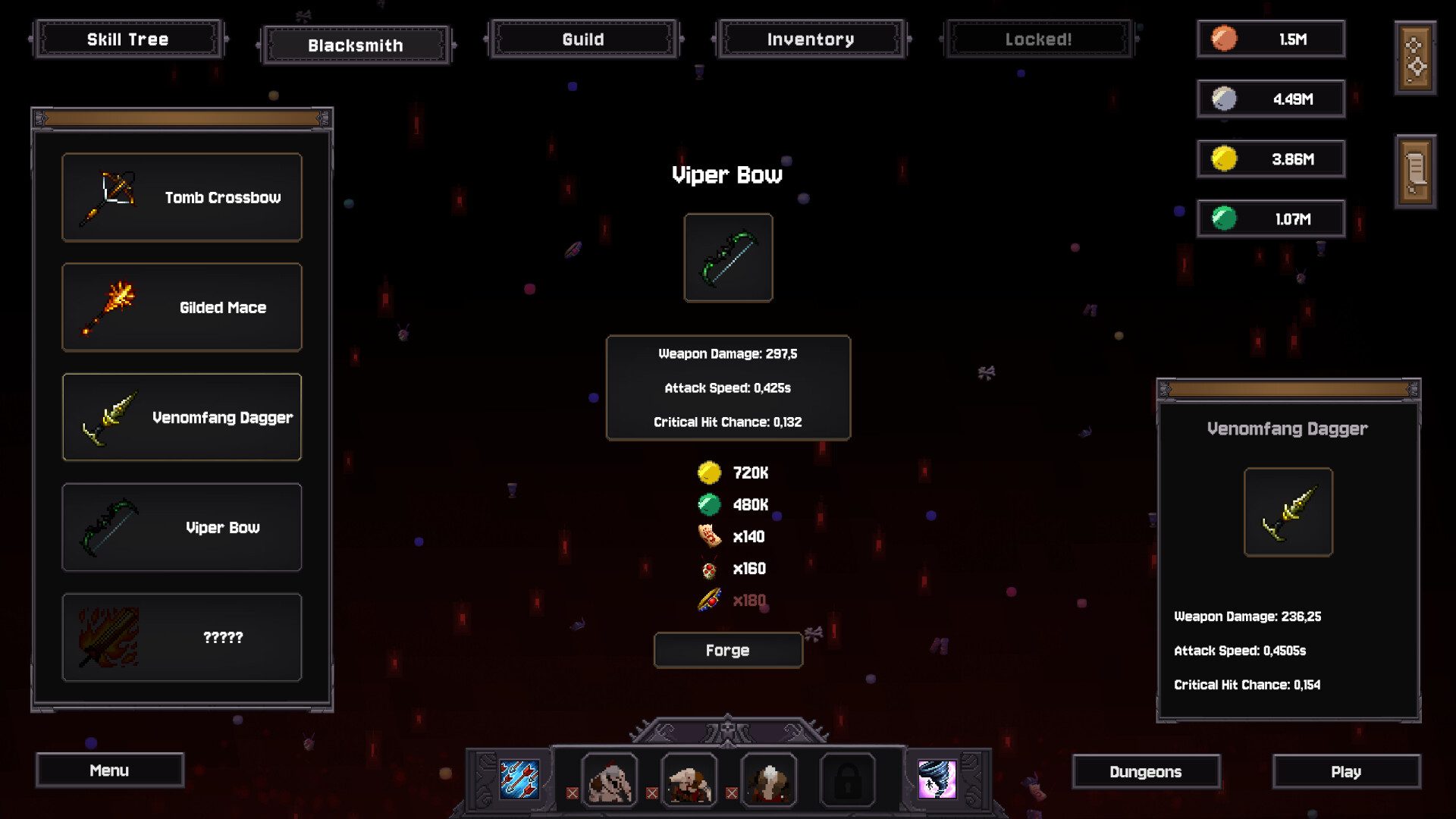
How to compare two weapons
Look at four things together:
- Damage per hit — useful, but incomplete.
- Attack duration / speed — a lower interval can make a lower-damage weapon win on throughput.
- Critical chance or special behavior — depends on your Skill Tree support.
- Attack shape / animation — matters enormously when rooms are packed with skeletons.
A weapon that clears three nearby targets cleanly can outperform a bigger single hit in a farming build.
Why crafting materials matter
The inventory tutorial specifically warns players to check items before upgrading or crafting because some weapons require particular drops. That turns enemy drops into a route-planning problem:- unlock the enemy that drops the required item;
- farm the correct dungeon room;
- raise item-drop support if the material is rare;
- keep enough of the material instead of selling it;
- then pay the currency cost at the Blacksmith.
The full game lists nine unique enemies with exclusive items, so later weapons are tied to where you farm, not just how much money you have.
When should you forge?
Forge when the next weapon fixes one of these problems:
- new-room enemies take too long to kill;
- your attack area is poorly matched to the room size;
- your Skill Tree now supports a weapon’s attack style;
- the new weapon is needed to keep coin-per-session growth ahead of upgrade costs.
Do not liquidate every crafting item just to afford a weapon one run earlier. If the next craft uses the same drop family, you may create a longer grind.
Common mistakes
Reading attack speed backwards. Some pre-release players explicitly paused to work out whether a displayed attack-duration value meant “attacks per second” or “seconds per attack.” Verify the live tooltip before assuming higher is better.Ranking weapons by sheet damage only. Animation, attack coverage and Skill Tree interaction can change practical clear speed.
Staying in the wrong dungeon for a missing item. Enemy-exclusive drops make room choice part of crafting.
Publishing a 16-weapon list from auto-transcribed names. This site will fill the database only after the live UI confirms exact names and recipes.