
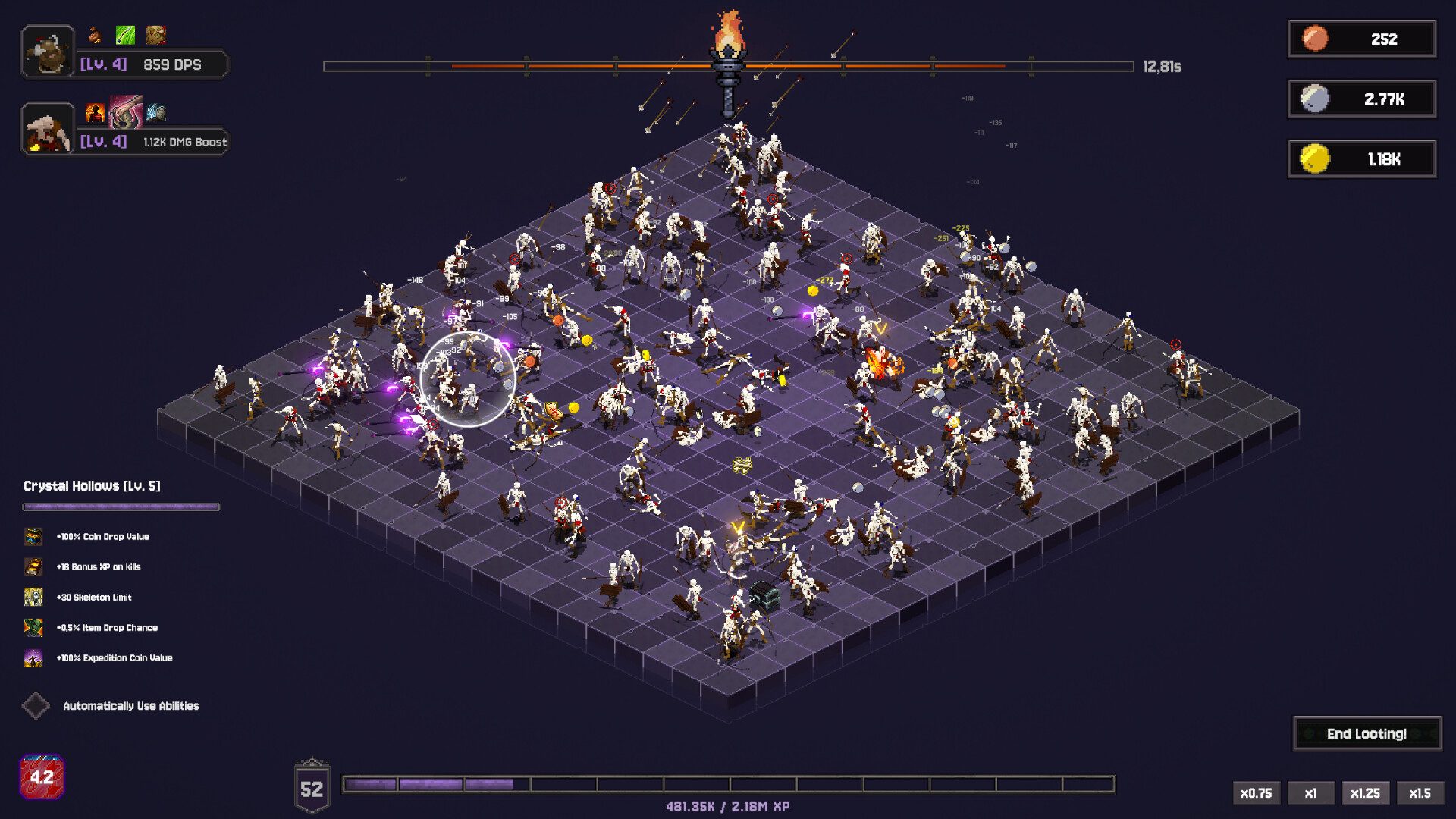
The early-game route
Bones and Coins is built around very short looting sessions. You sweep the attack circle over enemies, collect coins and items before the torch expires, then turn the haul into permanent upgrades. The trap is spending everything on whatever looks exciting. A smoother opening is to make every future run richer first.| Step | What to prioritize | What it fixes |
|---|---|---|
| 1 | Coin value / double-coin effects | More purchasing power every run |
| 2 | XP per kill / XP multipliers | Faster access to the wider tree |
| 3 | Skeleton count and spawn support | Prevents empty late-session downtime |
| 4 | Weapon area / enough damage | Lets the cursor clear clusters efficiently |
| 5 | Item drop chance | Starts feeding Blacksmith progression |
| 6 | First hero + party slot | Adds passive damage and unlocks Guild growth |
| 7 | New room | Opens higher-tier currencies, enemies and drops |
The exact node costs changed repeatedly during the demo, so this guide focuses on priority, not stale prices. The developer specifically rebalanced the Skill Tree and economy in demo v0.8.0, and the launch build expanded the tree again.
Do not sell every item immediately
One of the easiest progression mistakes is treating inventory drops as spare currency. The Blacksmith requires specific items for later weapons. Early-access playthroughs repeatedly stop to check the inventory because a weapon can be blocked by one missing material even when the player has enough coins.
If an item is marked as useful for forging, keep at least the amount needed for the next visible weapon. Sell obvious surplus only when you know what your next craft requires.
Recruit a hero before over-investing in solo cursor damage
The Barbarian appears early and gives you a second source of kills. As the Guild opens, hero upgrades start feeding party-wide effects and later synergies. The full game is designed around party composition rather than the demo’s more cursor-heavy balance.
The developer described the full version as having six heroes with large upgrade paths and cross-hero synergies. That makes early Guild access worth reaching even if the first hero looks modest at level 1.
Why this route works
The first bottleneck is not “can I kill one skeleton?” It is how much value can I extract from a ten-ish-second session. Economy, spawn density and XP improve the amount of progress each run generates. Damage matters when enemies begin surviving long enough to slow collection, not simply because a damage node is available.A useful rule is:
If you finish a session with enemies still alive everywhere, buy damage/area. If you finish with the room mostly empty and time still on the torch, buy more spawns, skeleton limit or progression.
That rule matches the game’s own development history: the developer changed late-session spawning because players were running out of worthwhile targets during longer rounds.
When to leave the first room
Do not rush a room unlock only because it lights up. New rooms introduce tougher enemies and a different currency mix. Move when:
- your current room is clearing comfortably;
- you can afford at least one or two useful upgrades after the room unlock;
- your weapon is not several tiers behind;
- you have enough item-drop support to begin collecting the next crafting materials.
You will still return to earlier rooms. The developer explicitly said the economy is intended to keep older coin types relevant instead of letting the first currency become useless forever.
Common mistakes
Buying session duration before you can populate the room. More seconds are weak when there are too few enemies left to kill. Pair duration with skeleton count/spawn effects.Ignoring item pickup. Early playtest feedback noted that players could miss items because coins and items did not always feel equally obvious. Watch the floor and inventory after a run.
Spending all materials on selling. The Blacksmith uses specific drops. Selling can solve a short-term currency shortage and create a longer crafting wall.
Sending your only strong hero on an Expedition. A hero assigned to an Expedition cannot be in the active party at the same time. Use an off-party hero unless the idle reward is worth the combat loss.