
Recommended route
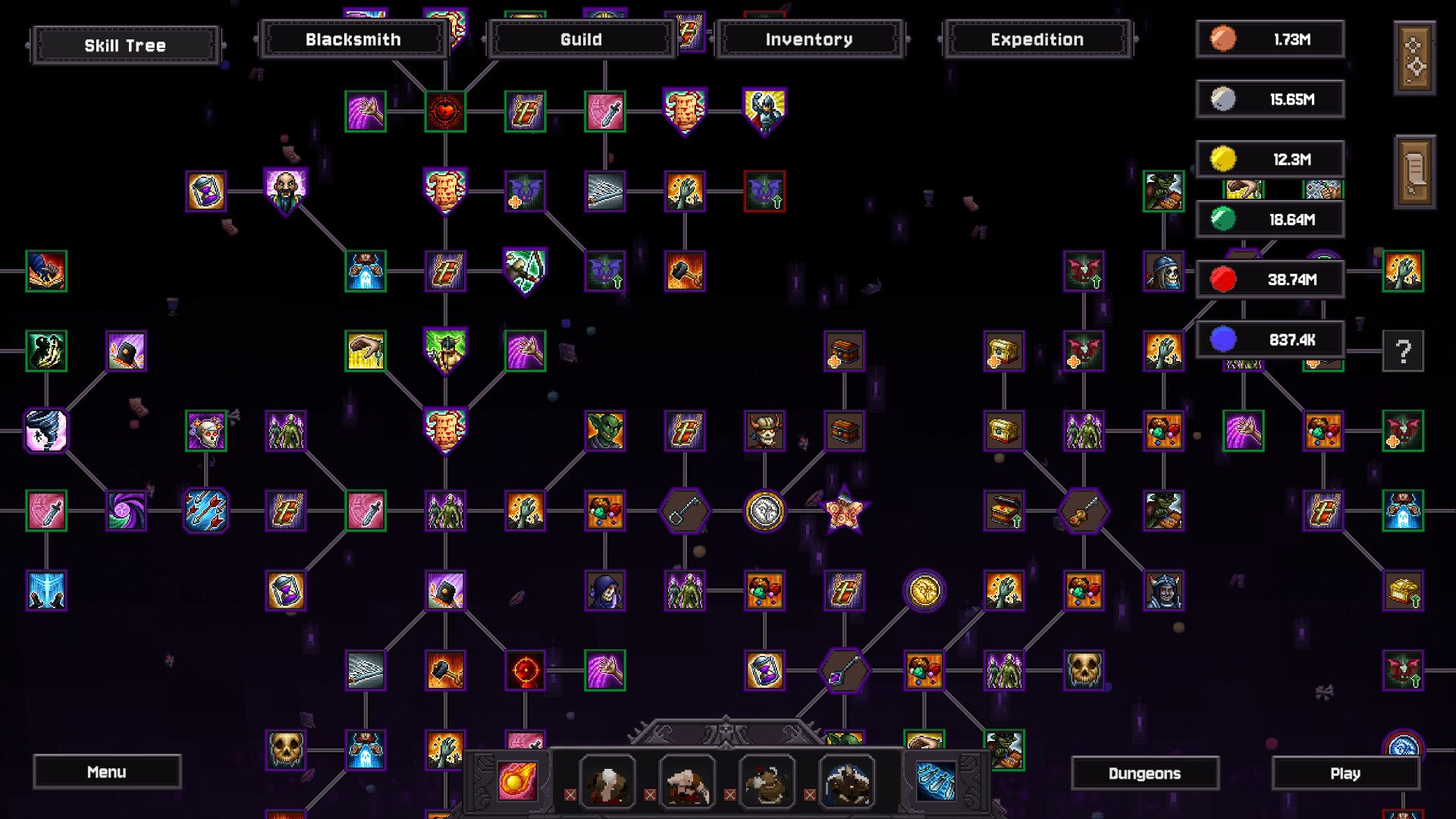
The most useful way to read the Skill Tree is as four overlapping zones rather than one linear build.| Tree area | Main job | Typical unlocks |
|---|---|---|
| Top | General growth | XP, broad multipliers, session support |
| Right | Progression | New rooms, enemies, coin tiers |
| Bottom | Combat | Weapon stats, damage, attack behavior |
| Left | Party | Guild access, heroes, party slots, hero support |
That quadrant explanation comes directly from the developer. The tree still crosses themes, so treat it as a mental map rather than a rigid diagram.
A good first pass
- Buy enough economy to make repeat runs productive.
- Add XP so the tree continues opening at a healthy pace.
- Fix spawn density before buying lots of session time.
- Unlock inventory/item support before you need the next crafted weapon.
- Pick up hero/party access as soon as it creates another real damage source.
- Unlock the next dungeon when your current room is no longer challenging.
- Return to damage and weapon nodes when tougher enemies slow kills.
This alternating path is stronger than tunnel-visioning down a single side.
160+ upgrades or 180 skills?
There is a real launch-source conflict worth knowing about. The current Steam store text says the full game has a “vast skill tree with 160+ upgrades.” A later-looking release-plan community post says 180 skills. Until the live build is counted directly, the safest wording is 160+ permanent upgrades, with the release announcement indicating the final total may be 180.We do not turn that discrepancy into fake precision. The site will update the count after the live build is verified.
Build archetypes the tree supports
Economy / farming build — coin value, double coin effects, chest/drop support, item value and room progression. Best when the next gate is simply expensive.
Cursor burst build — weapon damage, area, attack speed, crit and active abilities. Best when room clear speed is the bottleneck.
Party build — hero unlocks, party slots, Guild XP and cross-hero effects. Gets stronger later because full-game heroes have much larger trees than the early playtest versions.
Long-session build — session duration plus enough skeleton-limit and spawn generation to keep targets on screen. Duration without spawns is wasted time.
Common mistakes
Assuming every unlocked node must be bought immediately. Expensive progression nodes can wait while a cheaper multiplier improves several future runs.Ignoring the room you are actually farming. New currency tiers do not automatically make older currencies obsolete. The developer has said the design intentionally pulls players back to earlier rooms.
Treating pre-release costs as permanent. Demo v0.8.0 explicitly rebalanced existing Skill Tree costs. Launch and post-launch patches can do the same.
About respec
During playtest feedback, the developer confirmed that the full game would include a way to reset a hero’s upgrades, but intentionally did not reveal the method at that time. That statement was about hero upgrades; do not assume it means the entire global Skill Tree can be freely reset until the live build confirms it.